
Hydrogen, a viable alternative energy as from 2020
In this article, dedicated to alternative energies to diesel in road transport, we will show the advantages and limits of fuel cell, followed by a review of trucks and busses using hydrogen.
The 3 solutions developped by automobile manufacturers
Projects of busses using hydrogen
The Renault Maxity H2 tested in France
A viable alternative as from 2020
History and definition
A fuel cell uses a combustible, such as hydrogen (H2), and an et un oxidant, such as oxygen (O2), to create electricity and heat, and only rejects water vapour (H2O) : it is a clean energy. The principle is the contrary to electrolysis.
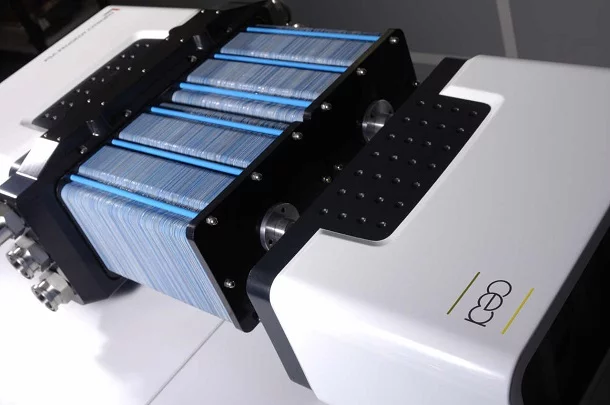 Une pile à combustible pour automobile
développée par le CEA en 2006. |
Discovered in 1839, the fuel cell only became an industrial prototype in 1953. It, then, was exploited by the NASA in the 1960s for the Apollo missions. Since then, lots of applications were developped, in various domains such as mobile telephony, construction and transport. Different combustibles can be used : hydrogen, le methanol, natural gas, ammonia...
Industrials are now looking to increase the energy efficiency, the battery's resistance and compactness and mainly reduce production costs, which are very high at the moment. An important quantity of platinum, a rare metal, or ion exchange membranes are needed for the making of these batteries but they are very expensive.
The 3 solutions developped by automobile manufacturers
For 10 years, automobile manufacturers present different prototypes integrating this technology, such as Michelin (F-City H2), Renault (Scénic ZEV H2), Toyota (Mirai), Hyundai (ix35 Fuel Cell), Honda (FCX Clarity) or Mercedes (NECAR, F-Cell and B F-Cell Hydrogen announced in 2017). Three different solutions have been developped :
- All hydrogen or « full power » models : the hydrogen fuel cell directly supplies an electric propulsion engine.
- Hybrid or « mid range » models : the hydrogen fuel cell supplies electricity that is used by the engine or to recharge a limited capacity battery.
- « range extender » models : the hydrogen fuel cell recharges the battery of an electric vehicle and ensures the heating of the vehicle.
Projects of busses using hydrogen
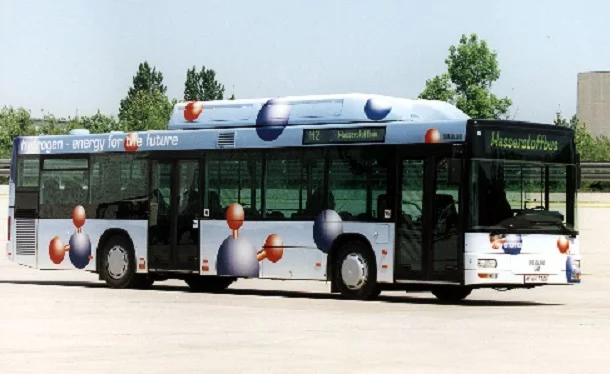 An experimental MAN hydrogen bus.
|
In Europe, truck manufacturers, especially German ones, started to get interested in this new energy in the mid 1990s. From 1996 to 1998, MAN was the first truck manufacturer to introduce in Germany a hybrid Neoplan bus with 12l and 6 cylinders thermal engine, supplied by liquid hydrigen or fuel. In 2006, several models of this prototype, with tanks of hydrogen stocked to 350 bars on the roof, were also brought into service in Berlin and then Frankfurt.
The hybrid hydrogen-electricity bus Mercedes Citaro
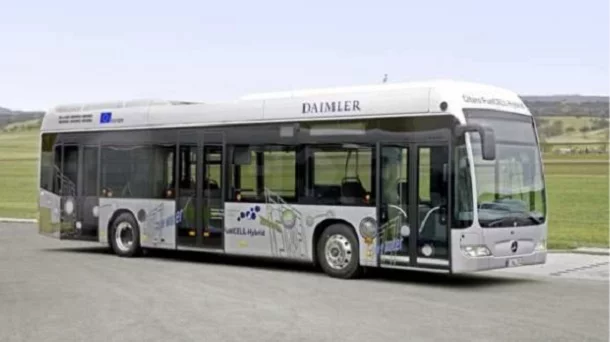 The Mercedes Citaro Fuel Cell Hybrid bus.
|
Daimler has been experimenting for a decade, in Europe but also in Australia and in China, a fleet a prototypes of fuel cell hybrid busses, developped from the Mercedes Citaro (projects CUTE, ECTOS, STEP, HyFLEET : CUTE and CHIC, currently underway until 2016).
The latest models of these hybrid Citaro busses are equipped with fuel cells of 120 kWe from the Canadian company Ballard, paired with a Li-ion 180 kWe battery. Their consumption is 10 to 14 kg of hydrogen for 100 km, against 20 to 25 kg for 100 km for the MAN busses with thermal engines directly supplied by hydrogen. With up to 33 Citaro Fuel Cell Hybrid Busses on the roads, Daimler is now the truck manufacturer with the most expertise on this technology.
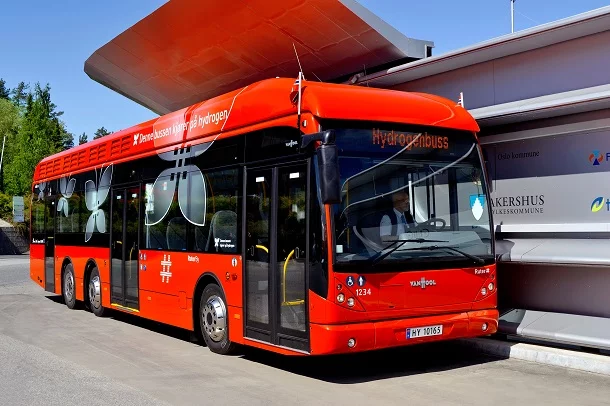 A Van Hool hydrogen bus.
|
A European consortium led by Van Hool
Scania took part of the Joule III European programm in 2001, to test an hybrid bus equipped with a 60-kWe fuel cell De Nora supplied by a hydrogen storage of 200 bars and paired with batteries. Iveco, via Irisbus, has also delivered in November 2004 three CityClass Fuel Cell busses in Italy, Spain and Germany.
Finally, Belgium manufacturer Van Hool, with its gained experience in the last 10 years with a fleet of 49 hydrogen buses on European and American roads, will lead from 2015 to 2019 the 3Emotion project. This European consortium, which includes 14 partners, is set to deliver 21 hydrogen buses equipped with Ballard fuel cells in the UK, the Netherlands, Italy, France and in Belgium, as well as 2 new charging stations.
The Renault Maxity truck H2 tested in France
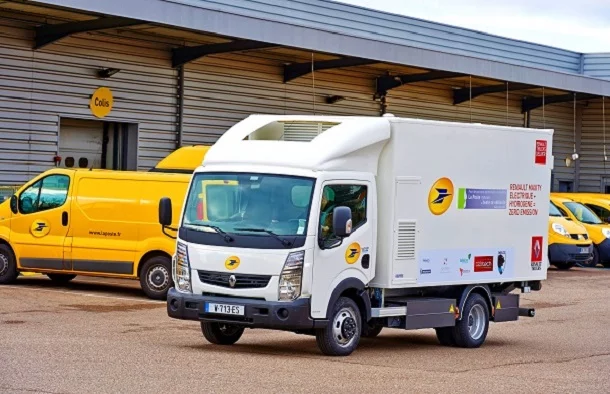 Ce prototype est testé par La Poste.
|
In terms of trucks using hydrogen, there is, to date, no models on the roads.
In Europe, Renault Trucks is a pioneer : since February 2015, French postal services are testing the prototype of the Renault Maxity H2.
This electric truck is equipped with a range extender, with 2 hydrogen tanks of 75 liters. Manufactured by Symbio FCell, the fuel cell doubles the Renault Maxity automony from 100 to 200 km. The heat produced by the fuel cell is used to heat the inside of the vehicle.
A viable alternative as from 2020
Hydrogen is not a short term alternative but could be viable after 2020. Its production cost is still high today, but decreasing regularly. Hydrogen fuel cells now offer a reasonable profitability for heavy transports, but there is no method, to this date, to transport the necessary quantities of gaseous hydrogen for long distance journeys.
Developped, tested and exploited for 20 years in 15 countries, the fuel cell bus seems to have reach its maturity. Today, the main manufacturers say that 500 to 1.000 new hydrogen buses should be on European roads between 2017-2020.

Editorial Manager
Practical information


We are on social media!
Top articles
Post a comment